As it is Holocaust Memorial Day (HMD) on 27th January, we explored the topic in a very child-friendly way as part of our Whole School Assembly this morning. Rather than focus on the barbarity and sheer numbers involved, I drew on the story of Ben Helfgott (now the Sir Ben below), a Holocaust survivor, with whom I travelled around Poland as part of my own undergraduate research in my early 20s. Ben become one of those voices that enters my head when there are ethical decisions to be made.
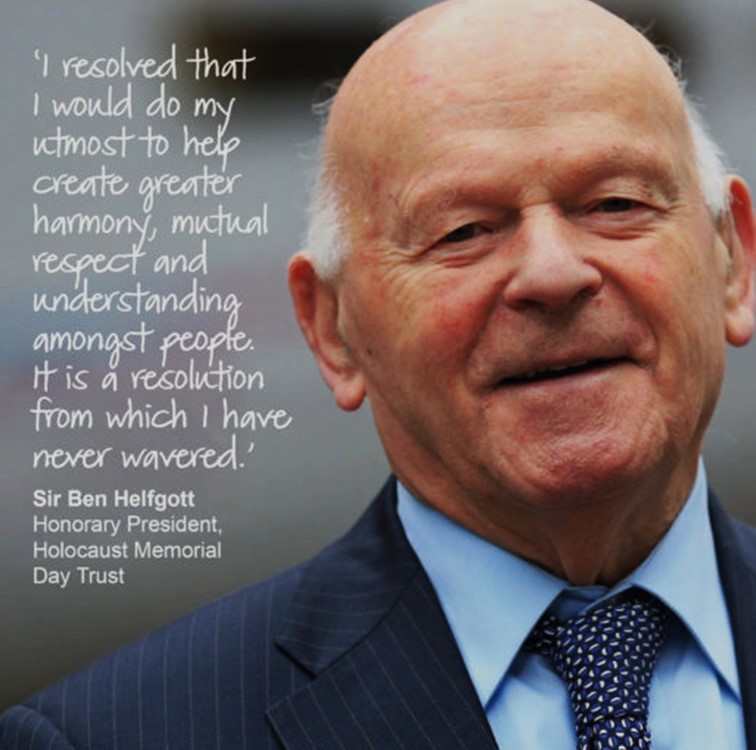
Ben was 10 when his family were moved to the ghetto in Lodz. Out of his immediate family of 10, only he and a sister survived until the end of the war, when he was evacuated to the UK. Ben went on to marry, have a large family and captain of the British weightlifting teams at the Olympics in 1956 and 1960. In my discussions with him, he also emphasised that although, especially as young people, we may sometimes feel powerless to change the events we see on the news regularly, we can make a positive impact on the world by our actions in our day-to-day lives. When we go to break, could we make sure everyone is included in our games, so no one is lonely? Could we stand up for someone to whom other people are being unkind, even if they are not our friend? Could you sit to next to someone at lunch who might be sitting on their own? In Years 7 and 8, perhaps we might include someone in your conversations, even if they are not normally part of our group? Like Ben, I would like the children to believe that they have the power and agency to change the world around them even at this stage in their lives.
This year’s HMD theme was Ordinary People, which emphasised that genocide is facilitated by ordinary people. Ordinary people turn a blind eye, believe propaganda, join the regimes who persecute and tyrannize. And those who are persecuted, oppressed and murdered in genocide aren’t persecuted because of crimes they’ve committed – they are persecuted simply because they are ordinary people who belong to a particular group (e.g., Roma, Jewish community, Tutsi).
Ordinary people were involved in all aspects of the Holocaust, Nazi persecution of other groups, and in the genocides that took place in Cambodia, Rwanda, Bosnia and Darfur. Ordinary people were perpetrators, bystanders, rescuers, witnesses – and ordinary people were victims.
In every genocide, those targeted faced limited choices – “choiceless choices” (Lawrence Langer, 2010) but in every genocide the perpetrators have choices, ordinary people have choices.
Sometimes, these choices were limited too, sometimes they had to make life-threatening decisions. And ordinary people were the ones who made brave decisions to rescue, to hide or stand up. But ordinary people also made decisions to ignore what was going on around them, to be bystanders, to allow the genocide to continue.
There are also extraordinary people in every genocide, remarkable and unusual people, who went to extreme lengths to help, to rescue, to save, and in every genocide there were extraordinary people, who went to extreme depths to cause harm, to persecute, to kill.
The HMD theme this year, though, highlights the ordinary people who let genocide happen, the ordinary people who actively perpetrated genocide, and the ordinary people who were persecuted.
For me, the theme also prompts us to consider how ordinary people, such as ourselves, can perhaps play a bigger part than we might imagine in challenging prejudice today. As we agreed in this morning’s assembly, if we can change one life for the better today, we have done an excellent day’s work.
#AHPrepLearning #AHPrepReflection #AHPrepHead #AHPrepCommunity
 Dr Trevor Richards