
As we have so much of our time reacting to the ever-evolving situation of late, as well as planning our responses to the possible scenarios ahead, I have become ever more mindful of the tension between urgency and importance in our work in school.
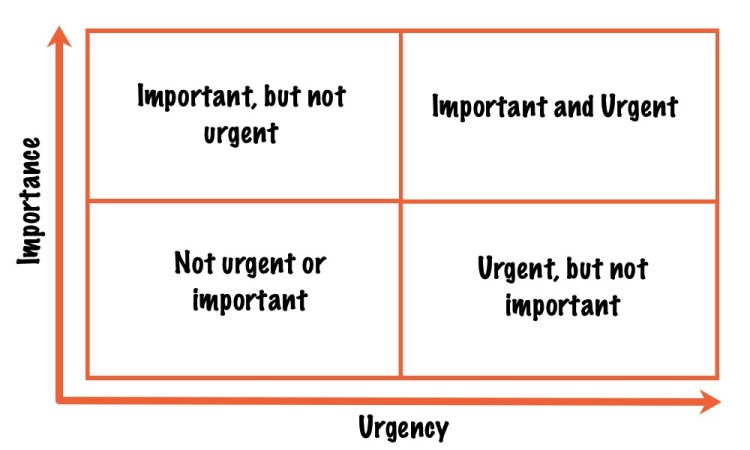
Some people tend to get urgency and importance confused. Urgency is how swiftly the issue needs to be addressed. Importance is how much the issue matters to us. When thinking about how best to allocate our time and resources, we can express these parameters as the diagram below, which was apparently employed by President Dwight D. Eisenhower. Perhaps the fact that our staggered drop-offs have reminded me of a finely honed military operation brought the above matrix to mind?
Often our temptation can be to focus on issues that matter and that matter right now. However, spending all of our time and vitality on these things can lead to increased stress, a feeling a of burnout, more mistakes, and a gradual decrease in our enthusiasm.
Equally, we can feel that we should be responding to matters that are important to others, but perhaps not to us. If it is urgent, it must be important to someone surely, but is this always the case? Alternatively, could our time be better spent where it will really make a difference?
If we are going to be most effective, we also need to spend time planning, preparing and thinking about big ideas, strategies, values and principles. It we do not do this enough; important issues will end up in the ‘Urgent’ box before we know it and we will all too often feel like we are fire fighting.
Vitally, particularly when we are young, I believe that we also need to spend time taking a break, playing, laughing, being silly, hanging out with friends or relaxing. Doing things that may not be critically important in the broader sense, nor particularly pressing. Perish the thought! This not only helps to protect our wellbeing and recharge our batteries, but can also help us be more creative and may be a time when we have our best ideas.
So, in our rush to respond to urgent matters, we will be endeavouring not to forget more fundamental and important matters in our school. We can too easily be consumed with admin, planning, risk assessments, logistics and spreadsheets, but we must always find time to build relationships with the children, see the world from their perspective, model those ethereal characteristics that are a critical outcome of their time with us and just catch up with all that is going on. In addition, it is not only the children that benefit from this time. As I know well, as adults we can only be revitalised and infected by the children’s dynamism, insights and ‘have-a-go’ approach to life when we are around them. Importantly, I would also like our children to begin to develop an appreciation for this type of thinking, though they seem to know instinctively how valuable it is to spend time on activities that adults might place in the ‘not urgent or important’ box!
 Dr Trevor Richards