
In last week’s newsletter, I drew attention to the plethora of statistics that appear to suggest that a growing number of young people are struggling with aspects of their mental health and well-being, despite measures of our standard of living signifying that in so many ways ‘we have never had it so good.’ It is easy to get side-tracked by the magnitude of some of the numbers involved, but we need to be mindful that we are talking about children and young people who are deeply unhappy, feeling overwhelmed, isolated and often lost within the situation in which they find themselves. Children at All Hallows, although privileged compared to many, are far from immune from the challenges and pressures brought about in their increasingly complex worlds, although they have some protection from the adverse circumstances many deal with on a daily basis.
Whilst schools and their staff may not be able to eradicate the taxing conditions in which some young people find themselves in, nor remove the traumatic events that life sometimes throws at them, they should have a significant role in building the mental resilience of young people in their communities, as well as supporting those who experience significant difficulties with their mental health and wellbeing (DfE, 2018; Public Health England, 2015; YoungMinds 2018; National Children’s Bureau, 2015).
“We cannot expect school staff to act as experts and or try to diagnose conditions” (DfE, 2018), but we can certainly aspire to provide the best environment possible for promoting positive emotional wellbeing. After all, children spend around 8,000 hours in school over the course of their education (OECD, 2014) and the skills, mindsets and behaviours that they develop whilst they are there can help build resilience and set the pattern for how they manage their mental health throughout their lives.
We endeavour to place children’s well-being at the centre of all we do; we try to ‘do’ education and support child development. It is at the core of our ethos and it guides much of our decision-making. I believe that we achieve the outcomes we do with our pupils because of this approach, not in spite of it! Therefore, on the brink of Mental Health Awareness Week, it seems a good time to reflect on how we might collaborate together to safeguard pupils’ wellbeing in the present and develop within them the resilience that will enable them to cope with future challenges. As we begin to tie up this phase of our own self-evaluation process and solidify our next steps, this topic has certainly been a theme that continues to reoccur in our deliberations.
For me, there are some central principles to any work schools undertake in this area, if it is to be truly effective:
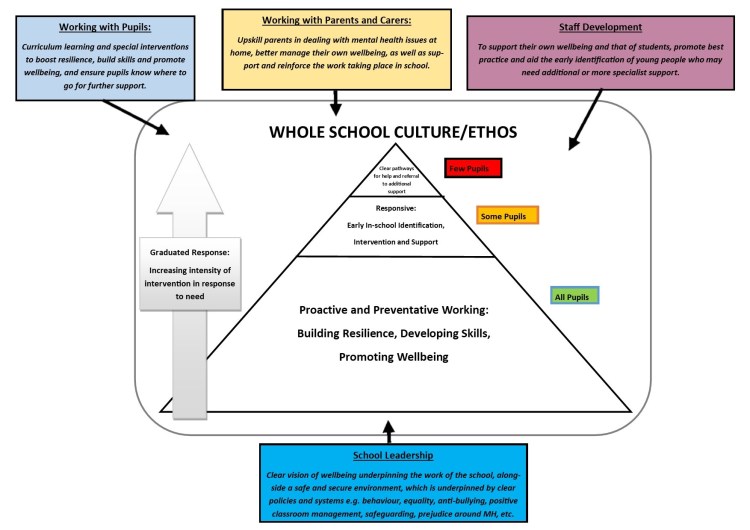
- Any programme needs to take place within a ‘whole school culture/ethos’. In the past, more often than not, programmes have sought to bring about change through interventions with a cohort of pupils, rather than simultaneously seeking to modify the wider cultures in which they operate. This results in firefighting with each batch of children at best and little change in many cases.
- Schools need to be working with all members of their communities to promote mental health and wellbeing – young people, parents and staff. Our work will be most powerful if we are all pulling in the same direction e.g. encouraging positivity; building positive relationships; focussing on strengths; fostering a sense of belonging and purpose; enhancing engagement; and nurturing a sense of accomplishment.
- Schools should adopt a graduated approach to mental health, which is made up for the most part of preventative work, but can also respond quickly when children require more intensive intervention or support. This may be provided in school initially, with the engagement of outside specialists and agencies if difficulties persist or are acute at the outset. I feel strongly that too much of our work in schools thus far has been focused on responding once young people are struggling. Surely we are better working with children and the people who care for them to do all we can to ensure they are mentally healthy, rather than simply attempting to treat them when they have difficulties? I welcome the advent of ‘Mental Health Leads’ in schools, but should we not be seeking primarily to develop our children’s resilience so that they do not become ill in the first place? Do we not also need to look at education as a whole, consider if there are aspects of our schools that are contributing to the problem and seek to go about these differently?
A well-being model for schools might therefore look something like the one below. This needs a little work, but I hope you get the idea.
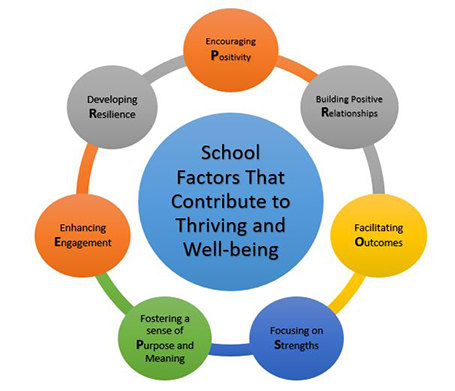
Even acknowledging that so much good work is already taking place at All Hallows, we have begun to make plans for specific sets of workshops, seminars, lessons and INSETs for all members of the community moving forwards. Initially, however, we have drawn on the PROSPER Model to help us begin to audit our current provision. The term ‘to prosper’ is defined as to thrive and succeed in a healthy way; to flourish (Oxford English Dictionary, 2018). We have used the PROSPER Model to help us define clearly the factors that contribute to flourishing, so that we can assess how we are contributing to well-being and where we have work to do. Based on Positive Psychology,
PROSPER proposes seven components which contribute to our thriving and well-being, as shown below:
Once the auditing is complete, we will then begin to embark on reinforcing any relative weaknesses, before contemplating how best to foster mental health and well-being in all parts of the community. I hope you will join us in these efforts. It may even have a positive impact on your own well-being perhaps?
I will leave you with a quote from Martin Seligman (2011), who challenges us all to develop a new concept of prosperity, which begins early in life: “The time has come for a new prosperity, one that takes flourishing seriously as a goal for education and parenting. Learning to value and attain flourishing must start early – and it is this new prosperity, kindled through education, that we can all now choose.”
One to discuss!
 Dr Trevor Richards