‘How we can help our children manage their stress levels and what parents can do to support them.’
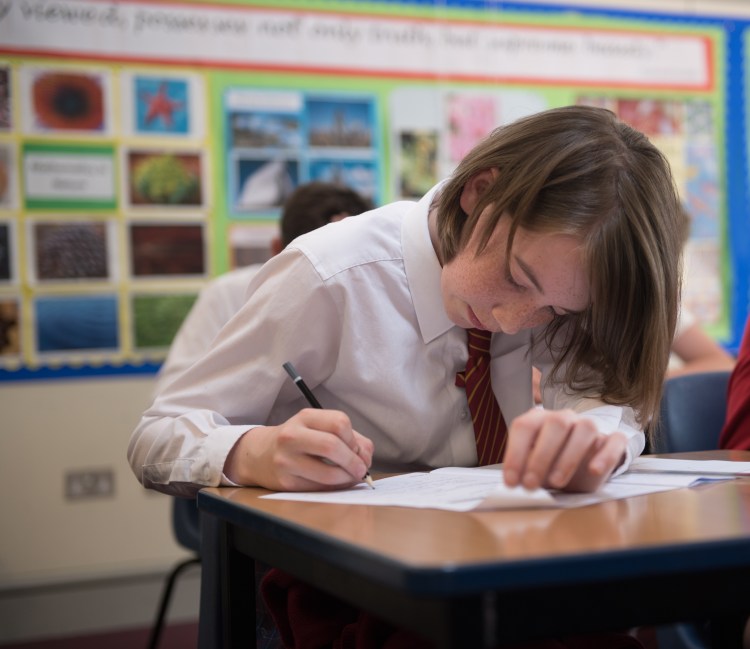
A core tenet of the All Hallows ethos is that the importance of fostering qualities that are hard to measure in our young people (such as emotional well-being, confidence, resilience and a positive growth mind-set) should not be an aside to the education process, but at its very foundations. Given that a good portion of our senior pupils are now immersed in a period of revision in preparation for some internal assessments, in this morning’s Whole School Assembly – with the help of some photos of very shocked babies and animals – we thought together about the physical and psychological roots of the worry and anxiety that some of us feel when undertaking tests and assessments, as well as how we might manage such feelings effectively.
We deliberately increase the formality of assessments steadily as the children progress through the school, in conjunction with developing the study skills and exam technique required to successfully navigate this part of our education. We also emphasise that pupils should focus on doing their very best, preparing well, working hard and using the results of any tests to establish the next steps or priorities for their learning moving forward. Whilst assessment results are certainly important – and will be part of each child’s educational journey for some time to come – I would ask you to help us in encouraging pupils to adopt a balanced approach to any tests they will need to complete over the next few weeks, as well as assisting them in handling any anxieties that arise. Boarding House Parents will certainly be seeking to take an active role in this process.
At a national level, parents have been criticised previously for how they go about supporting their children to do their best at school. Educator Sir Anthony Seldon labelled them as ‘clueless narcissists’ in a Telegraph article in 2015. The BBC have reported how overly controlling parents can harm their child’s mental health, and the Secret Teacher in The Guardian has suggested that ‘pushy parents’ were responsible for creating a ‘suffocating pressurised environment’, which eventually made their children miserable. Not only do I not recognise All Hallows’ parents in these descriptions – and I am not a fan of such all-encompassing statements in any case – but a recent study found that parents can have a big influence on their children’s mind-set, which is likely in turn to help foster positive emotional well-being.
The study found that parents who viewed failure as an opportunity to learn and improve were more likely to have children with a growth mind-set, whereas those who reacted to failures as a source of shame, embarrassment or negativity were more likely to have children with a fixed mind-set. Likewise, how parents react to success can also influence how their child subsequently thinks, feels and behaves. Another piece of research from the University of Chicago found that parents who praise their child’s processes and efforts following a success, instead of their natural ability, were more likely to have children who had a growth mind-set when measured several years later. As might often appear to be the case with research findings, this may well seem like common sense, but these two studies clearly show that how we respond to our children’s behaviours can have a significant impact.
Leading researchers at Loughborough University found that in order to nurture resilience, an environment must be both challenging, where setbacks may occur, and also supportive, where encouragement and advice are readily available. I hope that by working together, parents and teachers at All Hallows can continue to strike the right balance between both to ensure children do their very best, continue to make good progress and achieve heights they never considered possible, whilst simultaneously living life to the full and loving their time at school.
As we agreed in this morning’s Assembly, it is natural to feel slightly nervous at the start of any assessment, but school assessments should not pervade our thinking at every moment, influence our sleep, or impact negatively on our mental state. Please do not hesitate to contact Form Tutors, Class Teachers, Boarding House Parents and subject specialists if you have any concerns or questions before, during or after the assessment process.
 Dr Trevor Richards